
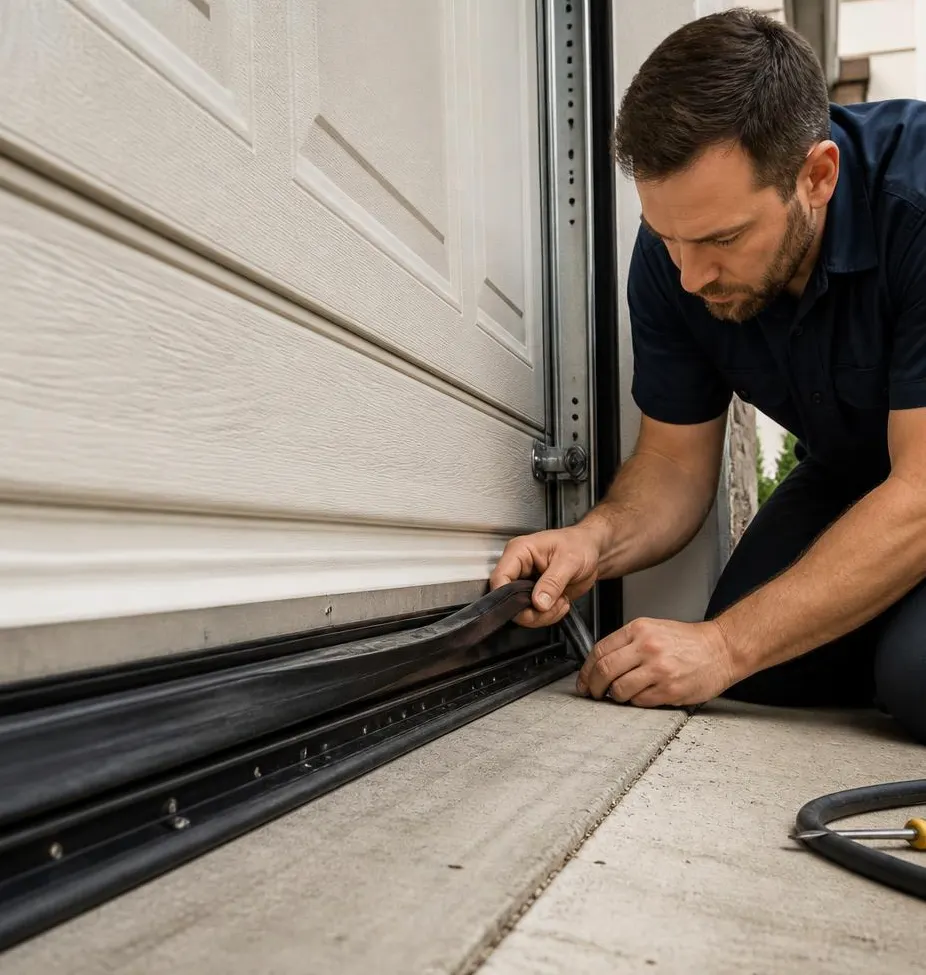
What a Technician Hears on a Typical Call
Most calls about a loud opener start the same way: "It's been getting worse for months, and now it wakes up the whole house." On arrival, the pattern is usually one of three things: a chain-drive opener with slack in the chain, loose mounting hardware vibrating against the ceiling joist, or an opener unit that's simply reached the end of its service life after years of temperature swings in an unheated garage. In this region, freeze-thaw cycles and humid summers make metal brackets expand and contract, and that slow loosening is often the real source of the racket, not the motor itself.
Step 1: Tighten Everything First
Tools needed: socket wrench set, screwdriver.
Before assuming the opener itself is failing, walk the length of the track and check every bolt — at the header bracket, the rail supports, and the mounting plate on the ceiling. A quarter-turn of looseness on several bolts adds up to a lot of rattle. Tighten them snug, but don't overtighten into the wood, especially on older homes with original framing that may already be worn around the fastener holes.
Step 2: Lubricate the Moving Parts
Tools needed: garage door lubricant (silicone or lithium-based, not WD-40 or grease).
Hinges, rollers, and the opener's drive screw or chain all benefit from a light coat of the right lubricant. Skip household oil — it attracts grit and gums up in cold weather. Apply, then run the door up and down a few times to work it in. This alone quiets a surprising number of squeaks and grinds, especially heading into a Merrimack Valley winter when cold makes metal parts stiffer and noisier.
Step 3: Isolate the Motor Unit from the Ceiling
Tools needed: rubber isolator kit (sold at most hardware stores), socket wrench.
A big source of noise isn't the opener itself — it's the motor's vibration transferring straight into the ceiling joists, which act like a drum. Rubber isolator blocks or washers installed between the motor bracket and the joist absorb that vibration before it travels into the house. This is a 20-minute fix that makes a disproportionate difference, particularly in homes where the garage sits under or near a bedroom.
Step 4: Adjust Chain Tension (Chain-Drive Openers Only)
A chain that's too loose slaps against the rail with every cycle. Most openers have a tensioning nut or bolt near the motor head — consult your owner's manual, loosen the lock nut, and adjust until the chain has a small amount of sag (usually around half an inch) without being overtightened, which strains the motor.
Step 5: Replace Worn Rollers
Tools needed: pliers, replacement nylon rollers.
Metal rollers are loud by nature and get louder as they wear. Swapping them for nylon rollers with sealed bearings is one of the most effective noise fixes a homeowner can do themselves. Do one roller at a time, leaving the door supported by the others, and avoid touching anything near the bottom brackets where spring tension is involved — that's a job for a technician.
Step 6: Consider a Belt-Drive Swap
If you've done all of the above and the opener is still noisy — or it's over 10-12 years old — the chain-drive mechanism itself may be the problem. Belt-drive openers use a reinforced rubber belt instead of metal chain, and they run dramatically quieter. This isn't a weekend DIY project: it involves disconnecting the old rail assembly, rewiring electrical connections, and properly calibrating travel limits and force settings so the door reverses correctly on an obstruction. Get this wrong and you end up with a safety issue, not just a noise issue.
What's DIY and What Isn't
- Homeowner-safe: tightening hardware, lubricating hinges and rollers, installing rubber isolators, adjusting chain tension, swapping worn rollers.
- Call a technician: full opener replacement, belt-drive conversions, anything involving the torsion spring system, travel limit or force setting adjustments, or wiring work.
When to Call Haverhill Garage Door
If you've worked through these steps and the noise is still there, or if the opener is old enough that a repair feels like a band-aid, it's time for a second opinion. Our Garage Door Opener Service covers everything from diagnosing a failing motor to a full belt-drive upgrade, done right the first time with proper calibration. And if it's been a while since anyone's inspected your hardware, our Preventive Maintenance visit catches the loose brackets and worn rollers before they turn into a 2 a.m. racket or a stuck door during the next nor'easter.
If your garage door opener in Haverhill, Methuen, Lawrence, or anywhere else in the Merrimack Valley is driving you up the wall, give Haverhill Garage Door a call — we'll quiet it down and make sure it's ready for winter.